MARRIAGE ASTROLOGY, WITHOUT THE VERDICT
Questions to ask an astrologer before marriage
A pre-marriage reading should help two people discuss compatibility with more honesty. It should not turn a score, dosha, or muhurta into permission to ignore consent and real-life evidence.

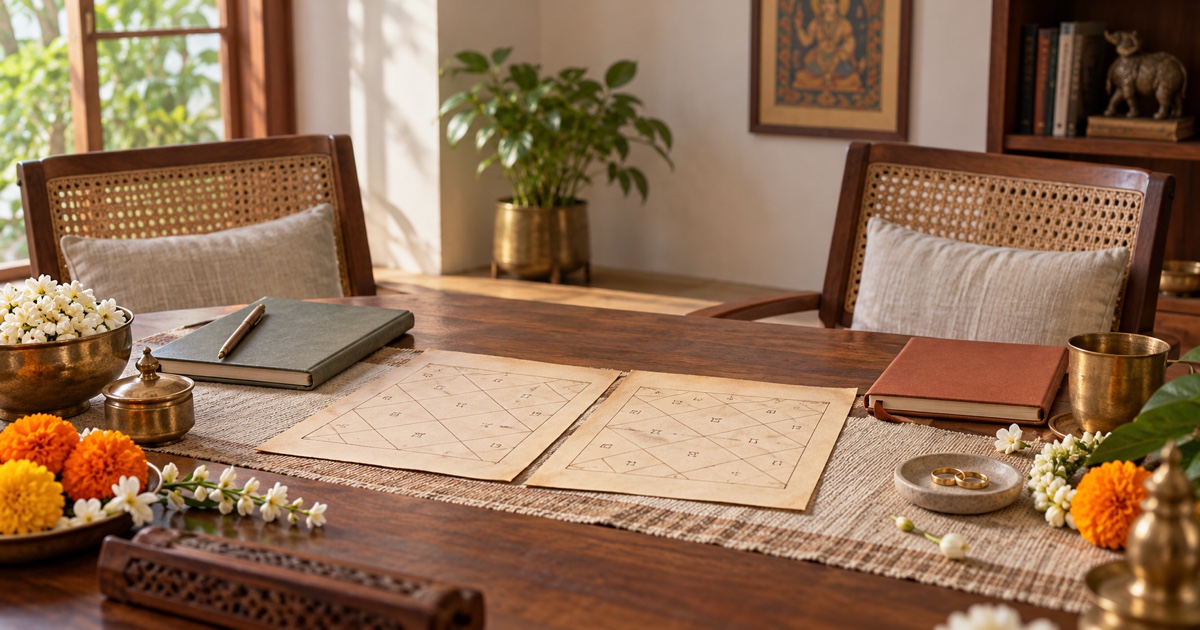
Ask for a conversation, not an approval stamp
The weakest pre-marriage question is “Are we allowed to marry?” It gives a calculation more authority than the two people whose lives are involved. A useful reading asks what the charts appear to emphasise, how confident the calculation is, and which real conversations still need to happen.
Begin with context. Is this a relationship both people freely want? Are families supportive or creating pressure? Is relocation involved? Are there differences around money, work, religion, children, caregiving, or privacy? Astrology can organise reflection around these subjects. It cannot decide them.
Questions worth bringing to a pre-marriage reading
About the calculation
- Which birth times and locations were used, and how were they verified?
- Which ayanamsha and matching method produced the result?
- How does birth-time uncertainty affect the Navamsha, houses, or timing?
- Which conclusions are robust, and which depend on a school-specific rule?
About compatibility
- Where do the charts suggest an easy understanding, and where might effort be needed?
- How might each person communicate under stress?
- What does the reading suggest about autonomy, closeness, and conflict repair?
- Are there differences in pace, emotional expression, or expectations that deserve discussion?
- Which apparent tension could become constructive, and which should not be romanticised?
About practical married life
- What themes relate to family boundaries and shared responsibilities?
- How should we discuss earning, spending, saving, debt, and financial independence?
- How might career ambition, travel, or relocation affect the partnership?
- What should we discuss about children without treating fertility as an astrological promise?
- How do we want to handle care for parents and extended family?
About timing
- What does the current dasha period emphasise for each person?
- Is the proposed wedding window being chosen for practical convenience, muhurta, or both?
- How should we respond if a “good” muhurta conflicts with safety, consent, health, travel, or legal requirements?
What the astrologer may examine
A traditional review may begin with Ashtakoota or Guna Milan, which scores eight categories using Moon signs and birth nakshatras. It may add Manglik or Kuja Dosha assessment, the 7th house and its lord, Venus and Jupiter according to the reader's school, the Navamsha or D9, and relevant dasha periods.
The important question is how these pieces are synthesised. A score of 18, 28, or 34 does not explain itself. A reader should show which kootas contributed to the total, whether a dosha rule has exceptions, and whether the broader charts support or complicate the screening result.
Our 36-point Kundali Milan methodology guide explains the eight rows and why calculators can differ. The calculator is useful for transparency, but it is not a marriage verdict.
The non-astrological checklist matters more
Before marriage, both people should be able to discuss values, money, debt, work, children, health, sexuality, living arrangements, domestic labour, religion, caregiving, privacy, and conflict. The answers do not need to be identical. They need to be honest enough for informed consent.
Do not use compatibility language to excuse controlling behaviour, humiliation, secrecy, financial abuse, threats, addiction, or violence. A favourable chart cannot make an unsafe relationship safe. A difficult score does not justify discrimination, fear, or pressure for expensive remedies.
समानी व आकूतिः समाना हृदयानि वः। समानमस्तु वो मनो यथा वः सुसहासति॥Samānī va ākūtiḥ samānā hṛdayāni vaḥ, samānam astu vo mano yathā vaḥ susahāsati.
Rig Veda 10.191.4 asks for shared intention, heart, and mind. It does not demand identical personalities. In a modern pre-marriage conversation, the verse points toward mutual purpose and the work of understanding.
Red flags in a marriage astrology reading
- A reader refuses to explain how the score was calculated.
- One dosha is used to frighten a family or shame one person.
- An expensive remedy is presented as the only way to avoid disaster.
- The reading predicts infertility, death, violence, or divorce as certainty.
- One person's consent is treated as less important than a muhurta.
- The astrologer makes claims about private medical, sexual, or legal facts without evidence.
Pre-marriage astrology questions
What should I ask an astrologer before marriage?
Ask how the comparison was calculated, where strengths and tensions appear, how uncertainty affects the result, and what practical conversations remain.
Is a high Kundali Milan score enough?
No. The score cannot establish consent, safety, communication, character, or shared life goals.
Can astrology guarantee a successful marriage?
No. A reading offers symbolic context. People, choices, behaviour, support, and circumstances shape the marriage.
Compare with consent
Ask a focused pre-marriage question
Share accurate birth details only with the other person's permission. Ask for the calculation and reasoning, not a one-word approval.
ASK BEFORE MARRIAGEEditorial process
Compatibility without coercion
Written by Radha. The guide was reviewed for calculation transparency, consent, safety boundaries, and consistency with Tarashastra's current Kundali Milan methodology.
Books and source context
Traditional frameworks referenced
- Bṛhat Parāśara Horā Śāstra, for traditional treatment of houses, planetary periods and divisional charts. Editions and chapter structures vary.
- Muhūrta Cintāmaṇi, for the broader classical muhurta tradition. This article does not turn an isolated rule into a universal wedding date.
- Rig Veda 10.191.4, for the quoted Sanskrit verse. The modern marriage application is editorial.