KUNDALI MILAN METHODOLOGY
Kundali Milan: how the 36-point score works
The eight Ashtakoota rows are useful when you can see the inputs, the arithmetic, and the limits. This guide shows all three without turning one score into a verdict on a relationship.

Direct answer
What is the Kundali Milan 36-point system?
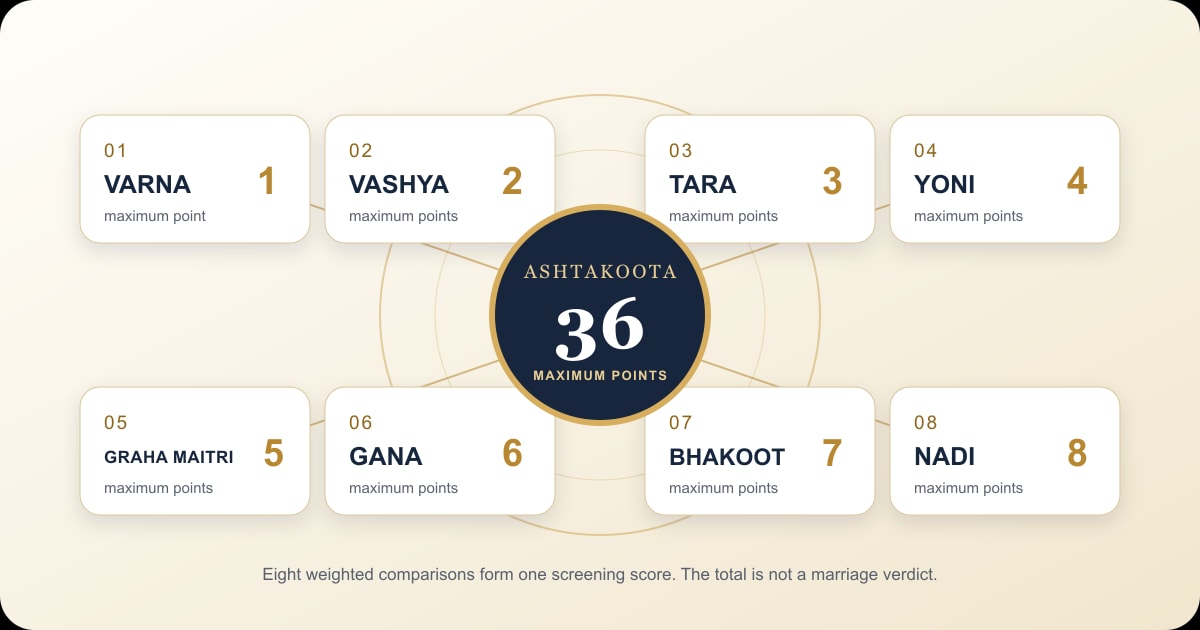
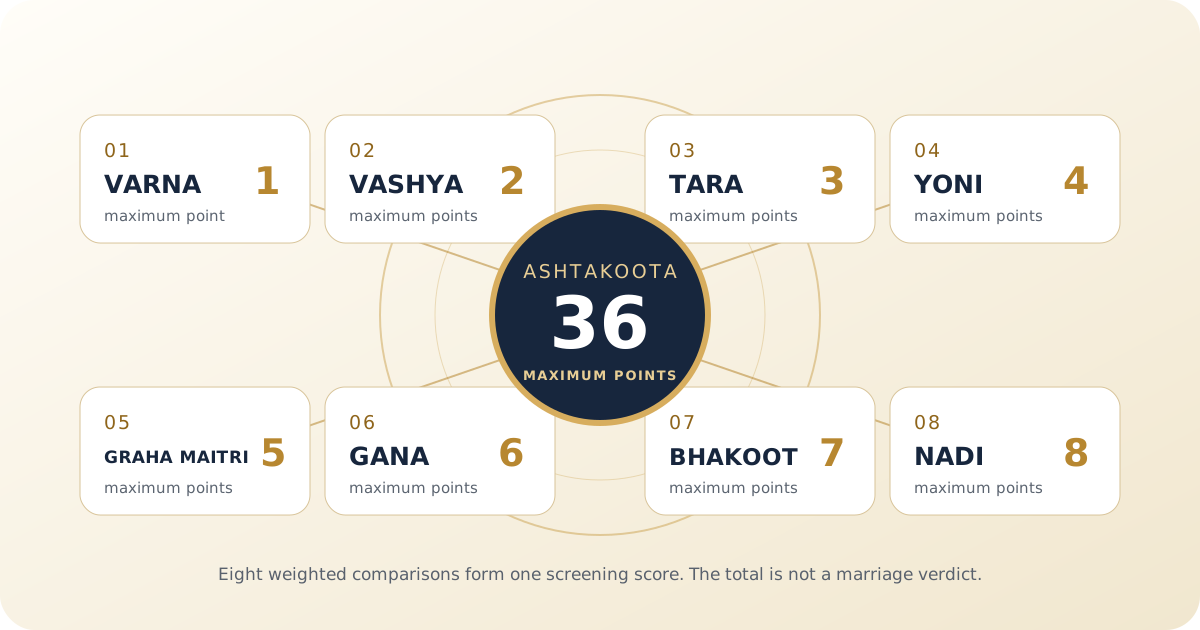
Kundali Milan, or Ashtakoota Guna Milan, is a North Indian screening method that compares two people mainly through their Moon signs and birth nakshatras. Eight weighted kootas contribute 1 to 8 points, adding to 36. A score such as 18 out of 36 is only a traditional threshold, not proof of compatibility. Whole-chart factors, lived behaviour, consent, and practical circumstances still matter.
Start with the inputs
What does Ashtakoota Kundali Milan actually compare?
The familiar 36-point score does not compare every planet, house, dasha, or event in two lives. Its core inputs are much narrower. A calculator derives each person’s sidereal Moon sign, birth nakshatra, and, where a rule needs it, nakshatra pada. The eight kootas then compare classifications or distances associated with those lunar positions.
This narrowness is not automatically a flaw. A screening framework is useful when it is described as a screening framework. The problem begins when the total is presented as if it measured the whole relationship. The ascendant, seventh house, Navamsha, Manglik assessment, running dashas, family circumstances, communication, consent, and personal values are not compressed into the number 36.
Different regions also preserve different matching systems. The Ashtakoota ladder is strongly associated with North Indian practice. South Indian matching may use a Dasakoota or porutham framework with a different set of checks. Calling those systems identical hides real differences in method.
The complete score sheet
Which eight kootas make up the 36 points?
The maximum weights rise from 1 to 8. Their sum is the origin of the famous total: 1 + 2 + 3 + 4 + 5 + 6 + 7 + 8 = 36. The descriptions below explain the traditional comparison category. They are not psychological tests, medical findings, or guarantees about future events.
| Koota | Maximum | Traditional comparison | Calculation anchor |
|---|---|---|---|
| Varna | 1 | A traditional hierarchy of disposition or orientation | Moon sign category |
| Vashya | 2 | Patterns of mutual influence expressed through symbolic groups | Moon sign classification |
| Tara | 3 | Birth-star relationship counted in both directions | Distance between nakshatras |
| Yoni | 4 | Instinctive and intimate compatibility in animal symbolism | Nakshatra yoni groups |
| Graha Maitri | 5 | Relationship between the lords of the two Moon signs | Moon sign lordship and friendship table |
| Gana | 6 | Temperament archetypes called Deva, Manushya, and Rakshasa | Nakshatra gana groups |
| Bhakoot | 7 | Relative placement of the two Moon signs | Moon sign distance |
| Nadi | 8 | A threefold traditional nakshatra classification | Nakshatra nadi groups |
| Total | 36 | A weighted screening total, not a percentage of relationship success | |
Varna and Vashya need careful modern language
Varna Koota comes from a traditional classification of Moon signs. It should not be used to rank a person’s dignity, caste, education, profession, or moral worth. Vashya uses symbolic categories to describe influence or responsiveness. It should not be turned into advice that one partner ought to control another. A modern explanation can describe the inherited calculation without endorsing social hierarchy or coercion.
Tara, Yoni, and Gana begin from the nakshatras
Tara counts the distance from one birth nakshatra to the other and groups that count into a repeating cycle of nine. Many scoring tables evaluate both directions, which is why a result can receive full, partial, or no points. Yoni assigns animal symbols to nakshatras and compares their traditional relationships. Gana places nakshatras into Deva, Manushya, or Rakshasa temperament groups. These are astrological symbols, not clinical personality profiles. Yoni cannot establish sexual compatibility or replace consent and honest communication.
Graha Maitri and Bhakoot use the Moon signs
Graha Maitri normally compares the planetary lords of the two Moon signs through a friendship table. A tool should say which lordship and friendship table it uses because implementations can differ. Bhakoot counts the relative positions of the two Moon signs. Certain relationships, commonly described by pairs such as 2 and 12, 5 and 9, or 6 and 8, may be treated as concerns in a given table. Practitioners also apply cancellation or exception rules, and those rules are not uniform across all schools.
Nadi carries the largest single weight
Nadi contributes up to 8 points, but that weight does not convert it into a medical test. The classification groups nakshatras into three traditional categories, often called Adi, Madhya, and Antya. Some traditions score different Nadis favourably and examine exceptions when the Nadis match. These categories must not be presented as evidence about genetics, pregnancy, fertility, disability, or a future child’s health.
Worked arithmetic
How should you read a synthetic score sheet?
The example below starts after a fictional rule table has assigned the row scores. It demonstrates the arithmetic and the right questions to ask. It is not tied to real people, and it is not presented as the output of every school or calculator.
| Row | Illustrative score | Maximum | What to inspect |
|---|---|---|---|
| Varna | 1 | 1 | Which Moon sign categories were assigned? |
| Vashya | 1 | 2 | Which symbolic group table produced partial points? |
| Tara | 1.5 | 3 | Was one nakshatra direction favourable and the other not? |
| Yoni | 2 | 4 | Which animal relationship table was used? |
| Graha Maitri | 3 | 5 | Which Moon sign lords and friendship rule were applied? |
| Gana | 5 | 6 | Which two temperament groups were compared? |
| Bhakoot | 7 | 7 | What was the Moon sign distance, and was an exception used? |
| Nadi | 8 | 8 | Which Nadi groups and exception rules were used? |
| Illustrative total | 28.5 | 36 | Read the distribution before the label |
A headline might call 28.5 a strong score. The table tells a more useful story. The larger rows contribute most of the total, while the middle rows remain mixed. The right next question is not, “Is 28.5 good?” It is, “Which inputs and lookup rules produced each row, and do the concerns described by those rows resemble anything visible in the real relationship?”
Do not convert 28.5 divided by 36 into a probability that a marriage will succeed. The weights are traditional scoring weights, not probabilities derived from a modern outcome study. A calculator can report the arithmetic accurately while a reader still overstates what the number means.
Reproduce before interpreting
Why can two Kundali Milan tools give different scores?
Different totals do not always mean that one program is careless. They can arise from different input handling or from a declared school choice. Before comparing the verdict label, compare the calculation record:
- Date and time: Was the date format unambiguous, and was the birth time copied correctly?
- Historical time zone: Did the tool apply the correct UTC offset for the birth date rather than today’s offset?
- Place coordinates: Did both tools resolve the same city and country?
- Ayanamsha: Did both use the same sidereal reference, such as Lahiri, Raman, or another declared choice?
- Boundary position: Was the Moon close enough to a sign, nakshatra, or pada boundary for a small input difference to matter?
- Lookup tables: Did both tools use the same Vashya, Yoni, friendship, Gana, Bhakoot, and Nadi tables?
- Direction and partial points: Was Tara checked in both directions, and did the program allow partial scores?
- Exceptions: Were Nadi or Bhakoot cancellation rules applied, and were those rules identified?
A responsible comparison begins by matching the two Moon longitudes, Moon signs, birth nakshatras, and padas. If those agree but the rows differ, the lookup or exception tables are the likely cause. If the Moon positions differ, fix the birth record and astronomical settings before debating the score.
This is also why a South Indian porutham result should not be forced into an Ashtakoota total. The systems overlap in subject but are not interchangeable score sheets.
Traditional framework, not a verdict
Is 18 out of 36 a pass or fail?
Eighteen is widely used as a practical midpoint because it is half of 36. Families and practitioners may treat 18 out of 36 as a threshold for further consideration, but the number does not carry the force of a universal rule. A score near the midpoint deserves more inspection, not a faster verdict. Which kootas contributed the points matters more than the label attached to the total.
The score cannot observe how two people handle disagreement, money, household work, religion, distance, family boundaries, affection, ambition, or care. It cannot establish whether both people freely consent to a marriage. It cannot detect abuse, coercion, addiction, deception, or immediate safety risk. Those questions require direct evidence and sometimes professional support.
Kundali Milan should never be used to reject, shame, pressure, or rank a person. Traditional categories are not measures of human value. The result should not override a person’s stated wishes, turn caste language into discrimination, or encourage a family to ignore harmful behaviour because the score is high.
The broader chart
What do astrologers examine beyond the 36 points?
Practitioners who use full-chart matching may examine factors that do not belong to the eight-row total. The exact method is school-dependent, so a reader should ask what is being considered and why. Common additional areas include:
- the condition of the seventh house and seventh lord in each natal chart;
- Venus, Jupiter, Mars, and the Moon according to the practitioner’s stated framework;
- Manglik or Kuja Dosha and the specific cancellation rules applied;
- Navamsha or D9 context, which depends more strongly on an accurate birth time;
- running dashas and major timing periods when the question concerns the timing of marriage;
- repeating themes that appear in both individual charts rather than one isolated combination;
- the real history, communication, choices, and circumstances of the couple.
None of these factors produces certainty. Adding more astrological layers can add context, but it can also add more assumptions. A useful reading should identify calculated placements, traditional interpretations, school choices, and uncertainties separately. Our guide to an online birth chart reading explains how birth-time accuracy affects that broader analysis.
If you are preparing for a consultation, bring clear questions rather than asking for a one-word approval. The guide to questions to ask an astrologer can help you separate practical concerns from a demand for certainty.
Common questions
Kundali Milan methodology FAQ
Is 18 out of 36 enough for marriage?
Eighteen out of 36 is a widely used traditional screening threshold, not an automatic recommendation to marry. Read the eight rows, check the calculation settings and exceptions, and consider the full charts and the couple’s real relationship.
Does 36 out of 36 guarantee a successful marriage?
No. A 36 out of 36 score does not guarantee a successful marriage. Ashtakoota cannot measure consent, communication, safety, shared values, changing circumstances or the work two people put into a relationship.
Can Kundali Milan work without an exact birth time?
Sometimes, but with caution. Ashtakoota depends mainly on the Moon sign and birth nakshatra. If the Moon was near a sign or nakshatra boundary, an uncertain time can change the result. Whole-chart analysis needs reliable birth times.
Why do online Kundali Milan calculators give different scores?
Calculators can use different time-zone conversions, ayanamshas, Moon positions, lookup tables, directional scoring rules and dosha exceptions. Compare the input record and the eight-row breakdown before deciding that either result is wrong.
Is Manglik Dosha included in the 36 points?
No. Manglik or Kuja Dosha is a separate chart assessment involving Mars and, depending on the tradition, the ascendant, Moon, Venus and cancellation rules. It is not one of the eight Ashtakoota rows.
Is Nadi Dosha a medical or fertility diagnosis?
No. Nadi is a traditional astrological classification used in the score. It is not a medical, genetic or fertility diagnosis and should never replace qualified healthcare or reproductive advice.
Understand your score in context
Ask what each row means for your two charts
Use the free Kundali Milan calculator for the breakdown. If you want to discuss the result, ask on WhatsApp or request a personal consultation. Bring clear questions and the calculation report rather than asking for a one-word approval.
ASK ON WHATSAPPTwo chart-based answers free · No card · No subscription · See pricing
Editorial method
Calculation first, interpretation second
Written under the disclosed house byline Krishna and reviewed through Tarashastra’s Jyotish and responsible-use checklist. The 1-to-8 point ladder was checked against the current calculator’s score architecture. The synthetic score sheet explains arithmetic and review questions; it is not a personal compatibility judgment.
Books and method notes
Sources used for this guide
- Muhurta Chintamani by Rama Daivajna, Vivaha-prakarana 6.21. The verse lists the eight categories in order and assigns successively larger weights. Sanskrit wording and supporting tables vary across editions.
- Uttarakhand Open University, Melapak evam Vivah, BAJY(N)-220, especially the teaching discussion that cites Muhurta Chintamani 6.21 and totals the eight weights as 36.
- Prasna Marga by Harihara, Volume II, Chapter 21 in the English translation and notes by B. V. Raman. This chapter discusses marriage compatibility through birth stars and a wider collection of kootas.
- Muhurtha (Electional Astrology) by B. V. Raman, Chapter XI. Raman’s practical discussion treats birth-star agreement as one part of a broader horoscope review.
- Horoscope Matching by S. C. Kursija. The book discusses the eight scored categories separately and cautions against treating Ashtakoota alone as a complete forecast of married life.
- How to Match Horoscopes for Marriage by P. V. R. Rayudu, Motilal Banarsidass, ISBN 978-81-208-3750-8. The book explicitly distinguishes a first-pass Moon and nakshatra comparison from broader chart factors and methodological choices.
The exact eight-category point ladder is directly cited here to Muhurta Chintamani 6.21. It should not be attributed casually to the Vedas or to one unverified verse of Bṛhat Parāśara Horā Śāstra. These books document astrological traditions; citing them does not establish medical or scientific causation.