PREPARE FOR A PERSONAL SESSION
Questions to ask during a personal astrology consultation
A short session becomes much more useful when you arrive with accurate birth details, a factual description of the situation, and two questions you genuinely need to think through.

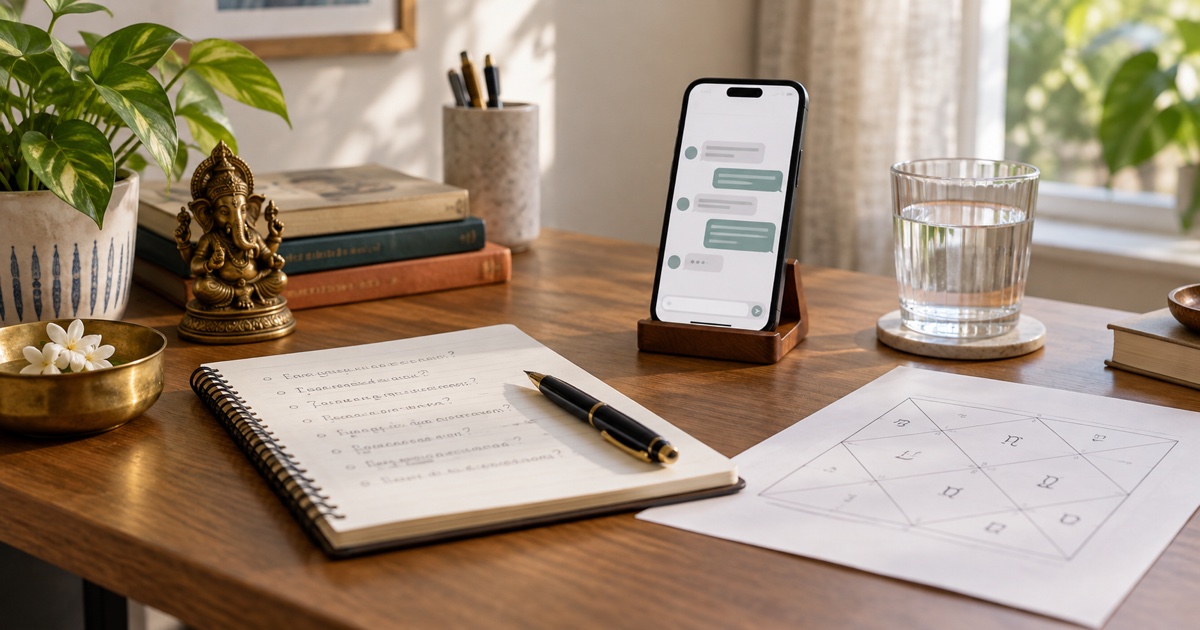
Bring two clear questions, not a test for the astrologer
A consultation is not more accurate because the astrologer guesses facts you have withheld. Share the situation honestly. The useful test is whether the chart factors and reasoning are explained, uncertainty is acknowledged, and the discussion helps you see the decision more clearly.
For a 15-minute session, choose one issue. For 30 minutes, two focused questions are usually enough. A 60-minute session can connect related topics such as career, location, family responsibilities, and timing without rushing each answer.
What to prepare before the session
- Your date of birth.
- Your recorded birth time, including AM or PM.
- Your birth city and country.
- The source of the time, such as a birth certificate, hospital record, family diary, or memory.
- Whether the time is exact, rounded, or uncertain.
- A three-sentence factual description of the current situation.
- Two questions written in advance.
- Any deadline that makes the decision time-sensitive.
Do not send another person's birth data without permission. Do not include passwords, identity documents, bank details, or medical records in a booking form or WhatsApp message.
Questions that create a useful consultation
For a current decision
- Which patterns in my chart are most relevant to this choice, and why?
- What strength could help me, and what habit could undermine me?
- Which part of the interpretation is supported by more than one chart factor?
- What practical information should I verify before deciding?
For career
- What work themes repeat across my birth chart and Dashamsha?
- How might the current dasha period shape responsibility, learning, visibility, or change?
- Which option fits my working style, and what evidence from the actual role could contradict that?
For relationships
- What relationship pattern should I examine in my own behaviour?
- How do I tend to communicate when I feel uncertain or rejected?
- Which compatibility question requires a real conversation rather than another calculation?
For timing
- What is the reasonable time range for this theme instead of one guaranteed date?
- Which dasha and transit factors are being used, and do they reinforce each other?
- How does uncertainty in my birth time affect the timing claim?
Ask how the answer was formed
You should be able to ask which house, lord, planet, nakshatra, divisional chart, dasha, or transit supports an interpretation. Not every answer needs a lecture, but the reasoning should be available.
If the consultation uses Vimshottari dasha, ask which Mahadasha and Antardasha are active and how their lords connect to the topic. If a divisional chart is used, ask whether the birth time is reliable enough for that chart. If a muhurta is suggested, ask which city and local time were used.
Good method questions protect both the client and the astrologer. They distinguish a considered interpretation from a confident sentence that cannot be checked.
What a consultation should not promise
An astrology session should not guarantee a job, marriage, pregnancy, investment return, court result, diagnosis, cure, or another person's behaviour. It should not ask you to stop medicine, ignore legal advice, take debt, remain in danger, or pay for a fear-based remedy.
If the issue involves abuse, self-harm, medical symptoms, legal deadlines, financial risk, or immediate safety, use the relevant qualified support. Astrology can remain a reflective practice without occupying a role it cannot safely perform.
कर्मण्येवाधिकारस्ते मा फलेषु कदाचन। मा कर्मफलहेतुर्भूर्मा ते सङ्गोऽस्त्वकर्मणि॥Karmaṇy evādhikāras te mā phaleṣu kadācana, mā karmaphalahetur bhūr mā te saṅgo 'stv akarmaṇi.
Bhagavad Gita 2.47 places attention on action rather than ownership of the outcome. After a consultation, the useful question is not “How do I force the prediction?” but “What responsible action is mine now?”
What to write down after the consultation
- The two or three chart factors the astrologer relied on most.
- Any uncertainty connected to birth time, school, or timing method.
- One practical action to take.
- One fact to verify independently.
- One observation to track over the next month.
- The point at which professional medical, legal, financial, or mental-health support would be more appropriate.
A useful session should leave you with greater clarity and agency, not dependence on repeated reassurance.
Personal consultation questions
What questions should I ask during an astrology consultation?
Ask about one or two current decisions, the patterns relevant to them, the reasoning behind the interpretation, uncertainty, and practical next steps.
What should I prepare?
Prepare accurate birth details, the source and confidence of the birth time, a short factual context, and two focused questions.
How many questions fit in 30 minutes?
Two focused questions usually allow enough depth. A long list often produces shallow answers.
Speak with an astrologer
Book a focused personal session
Choose 15, 30, or 60 minutes and arrive with clear questions. Tarashastra checks astrologer availability after booking.
BOOK A CONSULTATIONPrefer WhatsApp first? Ask about the session.
Editorial process
Preparation that protects your time
Written by Krishna. The guide was reviewed against Tarashastra's consultation flow, privacy boundaries, and responsible-use checklist.
Books and source context
Frameworks referenced
- Bṛhat Parāśara Horā Śāstra, for traditional bhava, dasha, and divisional-chart frameworks.
- Bhagavad Gita 2.47, for the quoted Sanskrit verse. The consultation application is editorial guidance.